

Naturally, when we feel attracted to others, we develop a strong need to be more connected to them and if possible, spend as much time with them as possible. When people are swept off their feet as a result of love, they get lost in the frenzy and their thoughts focus enjoying the moment while it lasts. As time progresses, some individuals recognize undesirable traits that they cannot put up with and their incompatibility makes them part ways. They learn to enter into new relationships as they seek to find partners with whom they can thrive and build a family. In this kind of romantic relationship, there is a healthy persistence of love with a characteristic intense affect and sustained sexual desire. However, the same cannot be said about obsessive love, generally described as love addiction.
Love Addiction
Guan et al. define love addiction as “excessive dependence, obsession, and immersion in a romantic relationship, persisting even when the relationship detrimentally affects mental health and well-being”. This often leads to compulsive behaviors including constant pursuit of new partners or idealization of harmful relationships followed by emotional distress that is usually similar to substance addiction. Research shows that love addiction is common among adolescents and young adults with several studies reporting significant prevalence rates among students and young adults in different countries across the world including the United States, Canada, Iran and Spain. Based on the findings, it is right to say that love addiction is a global issue affecting youths and young adults.
Evidence indicates that love addiction has a stronger relationship with stalking behavior among women compared to men. Whereas mutual love is characterized by mutual respect and reciprocation of romantic feelings from the involved partners, the same cannot be said of addictive love. In an addictive love relationship, there is strong love from one person but the person that is loved does not reciprocate. Surprisingly, in cases where romantic partners display obsessive love for each other, theirs is described as a mutual obsession as opposed to addiction.
Stages of Obsessive Love
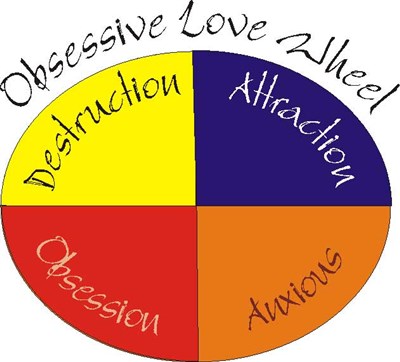
According to the obsessive love wheel, there are four stages of love addiction as described below:
Initial Attraction Stage
This is the first phase and it is characterized by overwhelming emotions and physical attraction which usually overlooks any signs of incompatibility between the two partners. The involved individuals only focus on physical and emotional characteristics and forget the personality traits. The obsessed person starts forming magical fantasies about their partner and starts exhibiting signs of control and obsession.
Anxious Stage
This is the second phase and it is characterized by the obsessed person’s creation of unrealistic and unreasonable fears of being abandoned or that their partner might be having another relationship. Unchecked, these notions can lead to depression or violent behavior.
Obsessive/Stalking Stage
This is the third phase and it is characterized by the obsessed person’s active behavior of following their partner, constantly calling them, stopping at their house or office without announcing, and constantly monitoring their partner.
The Destructive Stage
This is the final phase and it usually emerges when the person the obsessed person targets flees or leaves them. At this point, the obsessed person struggles with depression, substance abuse and suicidal ideations.
Factors that Influence Love Addiction
Different factors including attachment, separation anxiety and defense mechanisms have been implicated in addictive love.
Attachment
According to John Bowlby, attachment refers to the “innate human inclination to seek closeness and emotional connections with significant others”. Attachment theory posits that people develop different styles of attachment depending on the early interactions they had with their primary caregivers and the styles tend to persist from childhood into adulthood thus, having a strong influence on intimate relationships. Attachment can be either secure (usually characterized by a good consideration of oneself and others) or insecure, a major risk factor for the development of addiction including love addiction. Similarly, insecure attachment can be categorized into attachment anxiety and attachment avoidance.
Individuals who exhibit attachment anxiety are usually insecure about their emotional safety in relationships and they exhibit excessive dependence on their partners. They are usually worried about being abandoned, or suffering from loss of affection thus, constantly exhibiting closeness and overdependence. Furthermore, they constantly seek emotional reassurance and validation from their partners, which usually leads to exaggeration of their emotional expressions and an increased sensitivity to the responses that their partners make.
People who exhibit attachment avoidance tend to avoid physical and emotional closeness with the person they are attracted to. Instead, they have a high valuation of independence and find it difficult to reveal their vulnerabilities. When their emotional needs arise, they are usually uncomfortable and they are more likely to perceive emotional intimacy as a threat. Consequently, they struggle to seek help and strive at maintaining emotional distance and avoiding emotional investment.
Separation Anxiety

Attachment anxiety has been implicated in symptoms of separation anxiety among individuals. Separation anxiety is described as distress that arises as a result of an individual’s response to real or potential separation from a person that they are attached to. Individuals who were physically or emotionally neglected in their childhood, strongly crave to be loved, valued and approved. When a person who can meet their desires emerges, they put such a partner on the highest pedestal and find them to be perfect. However, the partner is meant to remain emotionally present for them and attempts by the partner to express their autonomy such as space, assertion of independence or setting of boundaries, are perceived as threats. They view their partner’s attempts as expressions of abandonment, lack of love and being unwanted. Their heightened feelings of anxiety drive them to cling and excessively depend on their partners as they constantly seek reassurance and closeness as a way of addressing their underlying fears of separation.
Warning Signs
When love turns into obsession or an addiction, it is no longer considered love. Instead, it becomes a psychological or behavioral issue that requires appropriate intervention. People may be deemed to have signs of obsessive love if:
- They have intense emotional dependence on their partner
- They are uncontrollably jealous
- They engage in obsessive surveillance or stalk their partners
- They express feelings of entitlements including beliefs that their partner belongs only to them, they cannot live without their partner, they are willing to kill anyone who threatens their relationship, and they have done or invested a lot in their relationship.
- They repeatedly text, call or email even when their partner has disapproved of their relationship
- They have difficulties in maintaining friendships or contact with family members because of the obsession they have for their partner or the one person they “love”
- They romanticize justifications for violent behavior
Studies indicate that there is a close relationship between love addiction or obsessive love and intimate partner violence such as coercion, stalking, domestic abuse and homicide. This outcome emerges when one partner is possessive, controlling and usually afraid of separation or abandonment. In extreme cases, rejection or separation can lead to deadly outcomes including murder under the guise of “love”.
Stages of Intimate Partner Violence in Obsessive Love
Through his Homicide Timeline Model, Dr Monckton Smith, a Senior Lecturer in Criminology at the University of Gloucestershire, reveals that intimate partner homicides progress in eight stages described as follows:
1. History
This is a stage preceding a relationship. Here the obsessed person has a history of stalking or abuse and controlling behavior.
2. Early Relationship
The romance develops quickly resulting into a serious relationship
3. Relationship
Here warning signs starting manifesting in the relationship. Coercive control and violence start dominating as the perpetrator starts exhibiting quick temper.
4. Trigger
The obsessed person’s control is threatened by a trigger such as separation or a threat of separation. A specific threat may also emerge which prompts the obsessed person to retaliate or seek revenge on the victim.
5. Escalation
There is an increase in the frequency or severity of the obsessed person’s control tactics such as threats of committing suicide, begging, violence or stalking. The perpetrator may also attempt to regain control.
6. Homicidal Ideation
Feelings of humiliation, injustice or revenge may force the obsessed person to try resolving issues through serious harm or homicide. The perpetrator may also target children and blame the victim for the actions taken.
7. Planning
Perpetrator buys weapons or seeks opportunities of getting the victim alone. They may also conduct research on the best way to carry out a homicide.
8. Homicide
The perpetrator ends up killing the partner and possibly, other people such as the victim’s children. After the homicide, the perpetrator may commit suicide or engage in denial or justification.
Treatment
Although most people avoid seeking treatment, few who do are subjected to cognitive behavioral therapy, group therapy and drug therapy.